Fountain pens · 9 May 2024 · 10 min read
Filling systems without the mystique
Cartridge, converter, piston, vacuum and eyedropper are just ways of getting ink from a bottle into a feed. Here is how they behave in Australian heat, and which ones we trusted on the counter.
By The Bookbinders desk
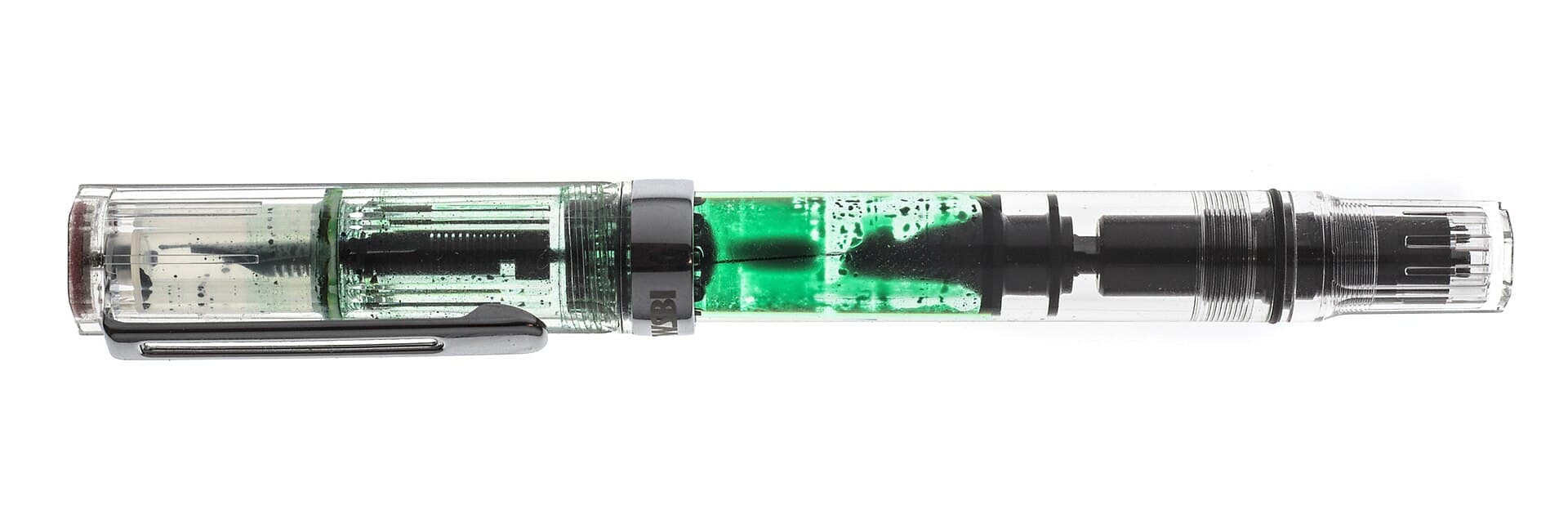
Image: Augustgeyler. CC BY-SA 4.0. See the image credits.

Ink has to get from the bottle to the page. Everything else — the romance of a piston, the theatre of a vacuum filler, the neatness of a cartridge — is a mechanism for that transfer. At the shop we spent as much time talking about filling as we did about nibs, because a beautiful nib on an empty, leaking, or impossible-to-clean pen is a paperweight.
Australian conditions make the mechanism less theoretical. Heat expands ink. Humidity keeps caps from drying the way a Berlin winter would. A converter that is only friction-fit will rattle loose in a beach bag. This is the map we used to draw on a packing slip.
Cartridges: the courtesy system
A cartridge is a sealed ampoule. You push it onto a nipple, it punctures, and you write. It is clean, legal in a shared office fridge, and limited. Proprietary cartridges lock you to a brand's colour list. International standard cartridges are more interchangeable and also more prone to being slightly the wrong length. Keep a spare in the tin. Do not keep a used cartridge "just in case"; it will dry into a plug.
Cartridges taught a generation of Australian students that fountain pens were possible. They also taught a generation to abandon the pen when the last blue cartridge was gone. Buy the converter on the same day. That sentence is the entire beginner curriculum.
Converters: the everyday adult
A converter is a miniature syringe or piston that lives where the cartridge would. Squeeze, twist, or slide, depending on the house. Pilot's squeeze converters are simple and hold less than you wish. Twist converters hold more and have seals that eventually tire. Some cheap converters are ornaments. If the converter that came in the box feels flimsy, replace it before you blame the pen.
Converters are how you try Iroshizuku without committing a piston's worth. They are also how you waste less ink when you decide the colour was a mistake. Clean them. A converter with last month's shimmer still in the corners will contaminate a careful grey. Our ink storage notes apply to the converter as much as to the bottle.
In heat, a half-empty converter is a chamber of expanding air. That is one reason pens burp on aeroplanes and in cars. Fill fuller than you think, or empty the pen for the flight. The mechanism is not haunted.
Piston fillers: the demonstrator's gift
A piston filler, like the TWSBI Eco that sat in so many of our "new arrivals" rows, turns the barrel into the reservoir. You twist the knob, the piston rises, ink comes in, you expel a little to set the feed. Capacity is the obvious advantage. The less obvious one is that you can see when you are about to run out, if the barrel is clear, and you can see when the ink has started to sludge.
Pistons want occasional grease on the right seal and a willingness to disassemble according to the maker's instructions, not according to a video shot in another climate. They do not want shimmer every week. They do not want to be over-tightened by a helpful hand. Read the TWSBI piece before you treat a cracked barrel as a personality trait.
A piston is a good desk pen and a good travel pen if you cap it and keep it out of the sun. It is a poor pen for someone who changes colour twice a day. Flushing a piston is more work than swapping a converter. That is the trade.
Vacuum, lever, and the vintage temptation
Vacuum fillers hold a lot of ink and have a satisfying plunger. They also have more opportunities to stain a shirt when the mechanism is misunderstood. We sold modern vacuums to people who already had a piston and a converter and a sense of humour. We did not sell them as a first pen.
Lever fillers and button fillers belong mostly to vintage. They are beautiful. They require sacs, knowledge, and a restorer. If you find one at a market in Paddington or Fremantle, budget for the restoration as part of the purchase price. A dry sac will look fine and then flood your notebook on the first warm afternoon.
Eyedropper conversions — filling a whole barrel with ink and sealing the threads with grease — are a hobbyist's sport. They can work in a small acrylic pen. They are a poor idea in a pale shirt pocket in Townsville. If you try one, keep the pen full. A half-empty eyedropper is a burp waiting for a temperature change.
Cleaning is part of the filling system
Whatever mechanism you choose, you are also choosing a cleaning ritual. Clear water, a bulb syringe if you like, patience, and the humility to flush until the water runs honest. Pigment inks and shimmer inks add steps; some of them add a warning not to use them at all in certain pens. Waterproof inks will outlive your regret in a feed.
We used to tell customers that a filling system is successful when they stop thinking about it. The cartridge that is always in stock, the converter that does not rattle, the piston that has not been over-greased, the vintage pen that has been given a new sac. Choose the least mystical option that matches how often you want to change colour, and then look after the pen in the climate you actually have.
Aeroplanes, mountains and the half-full mistake
Cabin pressure and altitude changes are just more heat-and-air stories. A half-full converter has air that will expand. A very full pen has less air. An empty pen has none. Choose full or empty before you fly, and keep the pen capped. Do not open it to "check" over a white shirt.
If you drive from the coast to a high inland town in a day, the same physics applies in miniature. Keep the pen out of the windscreen and you will probably be fine.
Choosing one system and learning it
A beginner who owns three filling systems owns none. Pick a converter pen or a piston pen for the first season. Learn the mess. Learn the clean. Then add a vacuum if you still want theatre. The mystique disappears when you can fill a pen without looking at a diagram. That disappearance is the goal.
Questions from the bench
- Is a piston filler better than a converter?
- It holds more ink and has fewer loose parts, which is better for a desk pen. A converter is better if you like changing colours often or want a cheaper barrel while you learn.
- Do eyedropper pens leak in the heat?
- They can, because a barrel full of ink is a lot of expanding liquid. Use silicone grease on the threads, keep the pen full or accept the burp, and do not leave it in a car.
Further reading
Fountain pens · 11 August 2024
Pilot in Australia, from Metropolitan to Custom 823
Pilot is the brand we could put in a beginner’s hand and in a collector’s, without changing the sentence about feedback, cartridges and service. Here is the family as it actually arrives here.
Fountain pens · 3 July 2024
Why TWSBI demonstrators changed the hobby
A clear piston you could actually afford made ink visible, capacity ordinary, and maintenance a conversation. It also taught a generation about cracks, grease and patience.
Fountain pens · 18 June 2024
Looking after a fountain pen in a humid Australian climate
Heat, salt air and a January glovebox will teach you more about feeds than any forum. This is the maintenance we used to write on the back of an Aspley receipt.